
Compost as teacher
Or as my friend wrote in a note: 'Tired: Composting queen; Wired: Decay Daddy'*

In 2020, I was gifted the Dobble Senior, a four-box-composting kit created by Daily Dump. In the four and a half years since, I have constantly composted — and always indoors. Sometimes reluctantly, sometimes with great enthusiasm, but consistently. I use the Dobble’s four boxes with holes (for air and for leachate to drip) piled one on top of the other. The bottom-most box spends the most amount of time in the decomposition process, and the top-most, the least. Which means the bottom box smells most like the earth after a rain — if the process has gone well — and smells like sewage if it hasn’t. Tending to it regularly is part of the process.
When I returned from my week-long trip to the mountains in April, I realised I had forgotten to mix and blend my compost before I left. As I opened the top bucket, I could smell (and see!) the full force of my neglect. I didn't yet have the energy needed to manage it immediately. Tomorrow, I told myself. Tomorrow came and the energy hadn’t, but the compost's demands were clear. Now, now, NOW. I placed a layer of newspapers on the balcony floor and set down the boxes I needed to work on.
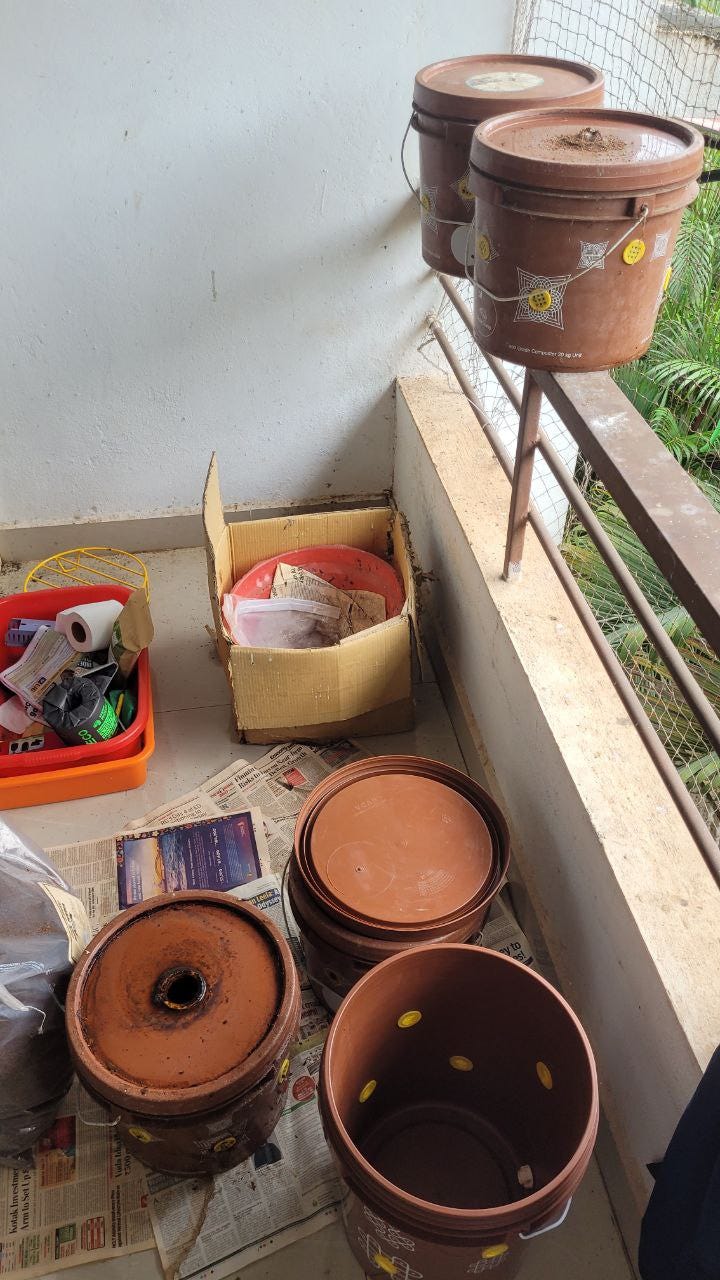
As I was sitting with my compost boxes, dealing with my neglect, I was thinking about healing. Composting helps mental well-being — this is something that is commonly heard. In a piece about composting's mental health benefits, Palome Jacome says that the "act of nurturing your compost pile, turning it and watching it decompose" can be therapeutic. Tending to my compost does leave me feeling grounded and grateful. But I have been pursuing another line of thinking for a while now: that the process of composting, the decomposition of turning waste into manure, is much like the process of healing.
Composting is often about balance. To begin the process, I open the top box, empty my wet waste into it, and then cover it up with some cocopeat (dust and smaller pieces of fibre from coconut husk). This process is the mixing of greens and browns, carbon and nitrogen, to find balance. The compost needs both to successfully decompose.
Then comes the decomposition: Decomposition is defined as “the process whereby organic material is broken down into its smaller molecules”. It is a step in the food chain, and seen as the nutrient cycle of an ecosystem.
One of the magical aspects of composting is slowly witnessing this process. In a piece for Orion Magazine on composting, Harrison Hill calls it the pleasure of "watching food de-manifest itself!" The process of feeding a box our scraps, vegetables and fruits we may have neglected (that are now rotting), the fish heads my cats won't eat, and occasionally a decomposable egg carton, and slowly watching them disintegrate over weeks and months, blending into each other.
When I first began to feed our compost the fish remains, I was nervous: everything online told me I was in for a stinky, messy affair. But the outcome was entirely different from what I expected. The decomposition was quick, and the compost - rich!
This decomposition, the breaking down of food into manure, feels similar to how I feel when life throws me a new hurdle, or my body presents me with a new symptom (or the revisiting of an old symptom). Dread knots in my stomach as I think of the weeks and months ahead. I wonder if my compost thought: Oh no, fish heads and guts!
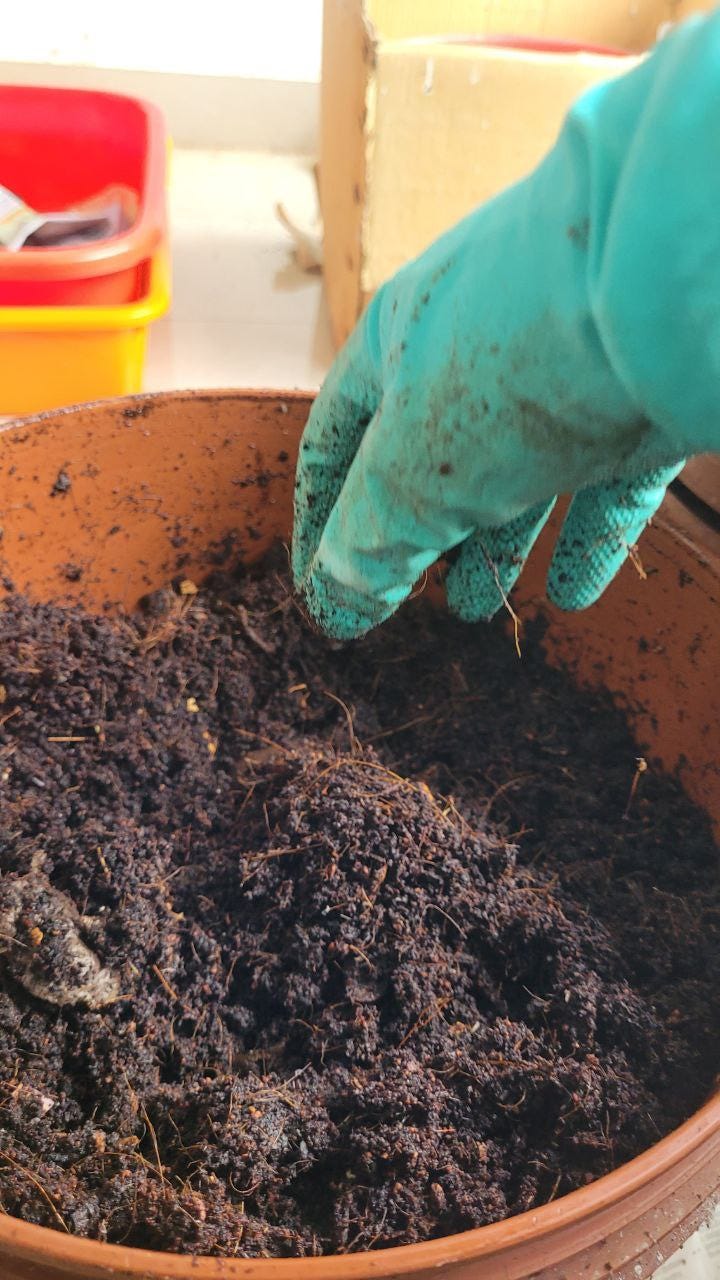
But like the compost, the body-mind is an ever-resilient thing. Slowly, the individuality of the symptom disappears and merges with my whole being. It wasn't helping me to see each symptom individually (something that chronically ill folk will tell you is frustrating about going to see doctors as they look at each symptom on its own: it feels like a step backwards). But seeing myself as an entire being to look after provided a crucial shift. The compost works in the same way. Rarely do I need to focus on the thing that isn’t, for whatever reason, decomposing as it ‘should’. Instead, I most often need to bring back balance, add moisture or heat, put a little medicine (neem), and shake it up well. Some adding, some removing, a return to a balanced state.
Some food does take time to decompose, like avocado and mango seeds are both tough to break down. These just go round and round in my boxes till they too eventually decompose and become part of the whole. There are several aspects of me that have longer healing arcs: my low self-esteem or even how deep and relentless the abyss feels on some days. They take more time, more food and nourishment, more effort and patience to break them down until they eventually become unrecognisable, a part of the whole.
In a blog on Permaculture Women's Guild, Dido Dunlop writes: "When we try to throw things out that smell bad, they don’t go away. That applies to emotions as much as food scraps and poo. We put our ‘waste’ in the compost heap so as not to waste rich resources: we know it transforms into nutritious soil. [...] Can we love our heart’s compost with equal delight? Can we rub our hands with glee and say[:] oh great! all my despair and misery will produce lots of rich emotional soil, and that’ll feed everyone else too [?]”
I am far away from rubbing my hands with glee — either for the compost or for my heart's pain. But I have begun to acknowledge the ways in which the breaking down, the tearing up, the falling apart have all helped enrich something else. Something made from those experiences and containing the elements that were part of the heart’s pain-heap. Dido goes on to ask in their piece about how we can embrace all aspects of our life better, in the manner that gardeners have to embrace the cycle of birth and decay.
In some ways, this aspect of decomposition, or at least the breakdown of existence, has been on my mind with regards to my mental health for at least a decade. I got a phoenix tattooed on my leg in 2013 as somewhat of an ode to this idea. Though unlike the phoenix rising from its ashes — looking magnificent as it soars — my compost reminds me to be patient. That transformation takes time and doesn’t always look majestic.
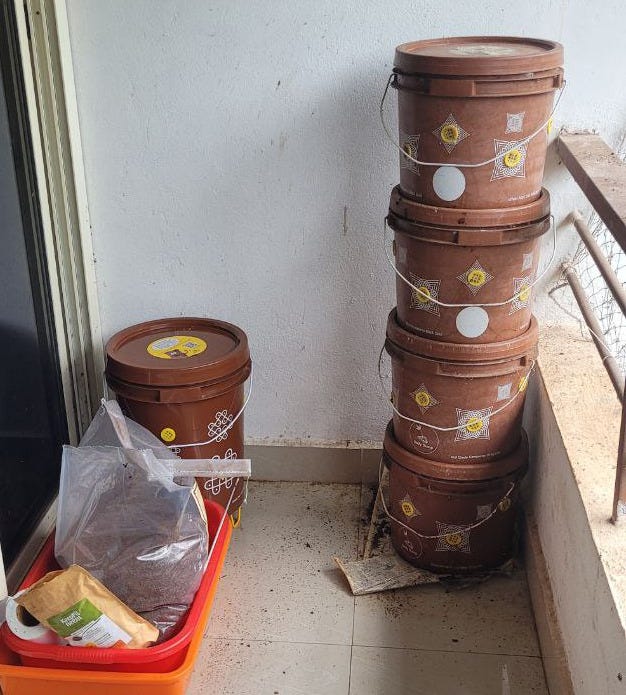
As I dig in the bucket to build air pockets, I think about the time decomposition takes. From the discards from our kitchen to the fresh rich compost, the journey is long and has many steps and supporting agents. The black soldier fly is the star of my compost. I went from making a face when I saw the maggots (its larvae) in my bucket, to talking to them while I tended to the compost, encouraging them and thanking them for their job. The smells too have taken a lot of getting used to, but I can safely say I am better at handling them now. The nasty smells tell the story of an imbalance and a reminder that the compost needs more caring for, not less.
A few days ago, I spent my entire therapy session weeping and feeling undone in so many ways. But my therapists, present and past, have helped me plod along, encouraging me to take my steps and do what needs to be done. To do the work of tending, over and over. And healing is often a messy, stinky, explosive affair, with more ups and downs than anyone warned me about.
In some ways, both composting and healing ask you to trust the process, and the process needs time, effort, love and patience. If I am lax with my compost for too long, I am bound to open it to a mess. Or even before I remove the lid, I see it has leachate leaking from the box — oh that dreaded sight. Healing, unfortunately or not, is the same. I find that if my grounding practices fall away, I am more on edge. If my ways to take care of myself have been sloppy, then it is bound to show up in the aches, the pains, the rising anxiety.
Composting has also been a process of letting go. Sometimes I walk to the balcony where my buckets sit with a heavy heart. Could be that this week too much rotted from neglect. But the compost accepts and decomposes with grace. I have to let go of the leftovers along with a stinking disappointment in myself. There is much to learn from it. For now, I sit with the compost and accept decay, decomposition and break down as ways forward. The smell of fresh earth — a nearly complete compost — wafts up to my nose.
*Decay daddy courtesy: MycoDyke.
Poetry for you (and me)
by Mirza Ghalib
translated by Jane Hirshfield
For the raindrop, joy is entering the river-
Unbearable pain becomes it's own cure
Travel far enough into sorrow, tears turn to sighing
In this way, we learn how water can die into air
When, after heavy rain, the storm clouds disperse
Is it not that they've wept themselves clear to the end?
If you want to know the miracle, how wind can polish a mirror
Look: The shining glass grows green in spring.
It's the rose's unfolding, Ghalib, that creates the desire to see-
In every color and circumstance, may the eyes be open
for what comes.
What would happen
by Jeff Foster
What would happen
if you removed
the word ‘anxious’
and just paid attention
to these flickering
sensations in the belly?
What would happen
if you took away
the concept ‘lonely’
and simply became
fascinated with this heavy
feeling in the heart area?
What would happen
if you deleted the image
‘sick’ or ‘broken’ or ‘bad’
and just got curious about
the tightness in the throat
the pressure in the head
the ache in the shoulders?
What would happen
if you stopped looking
for solutions and checked
to see if there was actually
a problem here?
Come out of the
exhausting storyline, friend.
It’s not true.
It was never true.
Commit sacred awareness
to a single living moment.
Come closer to yourself,
now...
Bring warmth to the
tender places inside.
Infuse sensation with
the light of attention.
It’s never as bad
as you think.
Instead of Depression
by Andrea Gibson
try calling it hibernation.
Imagine the darkness is a cave
in which you will be nurtured
by doing absolutely nothing.
Hibernating animals don't even dream.
It's okay if you can't imagine
Spring. Sleep through the alarm of the world.
Name your hopelessness a quiet hollow,
a place you go to heal, a den you dug,
Sweetheart, instead of a grave.
A few lovely things
Insights: Am I really disabled? by me
It is weird to put your own writing here. But I wrote this piece after ages of thinking about it. So would love your thoughts on it <3
A poem about anxiety, a comic about a bird - Must read.
I have a set of three compost bins from Dailydump which I got in 2021. I did the process for 2 years.. and left home.
I'm back to home again and I wanted to restart the whole process. This essay is the final push for me to restart.
Also, daily dump has been closed I guess. And I don't know how to get the starter packs again. Can you help?
So lovely! And so much resonance! As a long time composter, I have found that the moments I tend to my compost less are also moments my own care is scarce! And tending to the compost itself is grounding and caring for myself! The interconnectedness of it all fills my heart! What a lovely ode to that this piece of writing is